

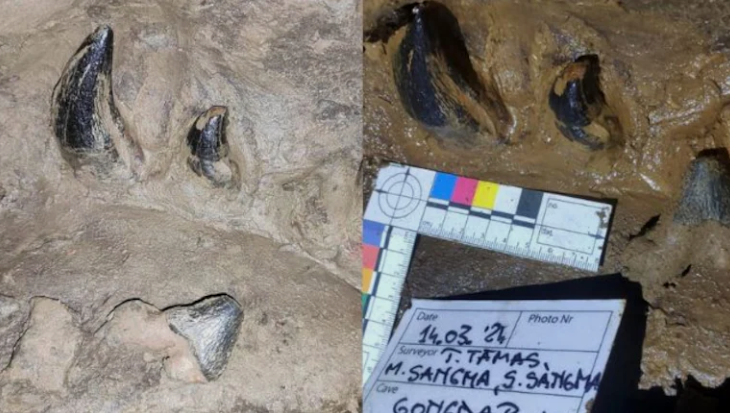
In February 2024, a team from Core Geo Expedition discovered rare fossil remains at Gongdap village near Tolegre in South Garo Hills, Meghalaya. Preliminary examination by the Geological Survey of India (GSI) suggests the fossils are 35–40 million years old and belong to extinct marine mammals such as Rodhocetus or Ambulocetus, which are regarded as early ancestors of modern whales.
Key Highlights
- The fossils date back to the Eocene Epoch (about 56–33.9 million years ago).
- They indicate that large parts of present-day Meghalaya, particularly the Garo Hills and Shillong Plateau, were once submerged under a shallow sea connected to the ancient Tethys Sea.
- The discovery provides valuable evidence for the evolution of whales, tracing their transition from land-dwelling mammals to fully aquatic mammals.
- It is one of the most significant palaeontological discoveries in Northeast India.
- A scientific method used to determine the age: Carbon Dating (Radiocarbon Dating)
About the Geological Survey of India (GSI)
- Established: 1851
- Ministry: Ministry of Mines
- Headquarters: Kolkata, West Bengal
- Motto: Geology in the Service of the Nation
- Functions:
- Geological mapping of India.
- Mineral and groundwater exploration.
- Fossil and palaeontological studies.
- Geotechnical and geo-environmental investigations.
- Landslide, earthquake, and natural hazard studies.
- Preparation of geological maps and reports for resource management.
Significance: GSI is India’s premier geoscientific organisation and plays a crucial role in understanding the country’s geology, mineral resources, and prehistoric life.
About Garo Hills
- Located in the western part of Meghalaya.
- Divided into five districts:
- West Garo Hills
- East Garo Hills
- South Garo Hills
- North Garo Hills
- South West Garo Hills
- Inhabited predominantly by the Garo (A’chik) tribe.
- Forms part of the Garo-Khasi-Jaintia Hills.
- Rich in limestone, coal, fossils, biodiversity, and caves.
- Important rivers include Simsang (Someshwari), Ganol, Didak, and Ringgi.
- Nokrek Biosphere Reserve, a UNESCO-recognised biosphere reserve, is located in the Garo Hills.
- Nokrek is famous for the Western Hoolock Gibbon, Asian elephant, clouded leopard, and wild citrus gene pool, not the Red Panda.
About the Shillong Plateau
- An ancient Precambrian plateau composed mainly of granite and gneiss.
- Located between the Brahmaputra Valley in the north and the Bangladesh plains in the south.
- Separated from the Peninsular Plateau by the Garo-Rajmahal Gap.
- Includes the Khasi Hills, Jaintia Hills, and Garo Hills.
- The plateau contains extensive deposits of coal, limestone, uranium, and other minerals.
- Geological evidence suggests that parts of the plateau were submerged under the Tethys Sea during the Eocene, explaining the occurrence of marine fossils.
Why is the Discovery Important?
- Provides direct evidence that Meghalaya once had a marine environment.
- Helps scientists understand the evolutionary history of whales.
- Strengthens India’s palaeontological record.
- Promotes geological research, heritage conservation, and geotourism in Meghalaya.
- Enhances Meghalaya’s importance in global studies on ancient marine ecosystems.
Practice Questions
1. A significant fossil discovery in the State of Meghalaya in February 2024, estimated to be around 30 to 40 million years old and believed to be an ancestor of modern whales, is located in:
MPSC SDO/AE (PHE & PWD) 2026
(A) North Garo Hills District
(B) South Garo Hills District
(C) West Khasi Hills District
(D) East Jaintia Hills District
Answer: (B) South Garo Hills District
2. The Geological Survey of India (GSI) functions under:
(A) Ministry of Earth Sciences
(B) Ministry of Environment, Forest and Climate Change
(C) Ministry of Mines
(D) Ministry of Science and Technology
Answer: (C) Ministry of Mines
3. The ancient marine fossils discovered in Meghalaya belong to which geological epoch?
(A) Jurassic
(B) Cretaceous
(C) Eocene
(D) Pleistocene
Answer: (C) Eocene
4. The Shillong Plateau is separated from the Peninsular Plateau by the:
(A) Siliguri Corridor
(B) Garo-Rajmahal Gap
(C) Palghat Gap
(D) Nathu La Pass
Answer: (B) Garo-Rajmahal Gap
5. Which of the following hill ranges form the Shillong Plateau?
- Garo Hills
- Khasi Hills
- Jaintia Hills
Select the correct answer using the code below:
(A) 1 and 2 only
(B) 2 and 3 only
(C) 1 and 3 only
(D) 1, 2 and 3
Answer: (D) 1, 2 and 3
6. In which year UNESCO added Nokrek National Park to its list of Biosphere Reserves?
JE(MECH)2023
(A) 1999 (
B) 2003
(C) 2005
(D) 2009
Answer: (D) 2009
7. Carbon dating is primarily used to determine the age of:
(A) Igneous rocks
(B) Organic remains such as wood and bones
(C) Metallic ores
(D) Sedimentary rocks
Answer: (B)