

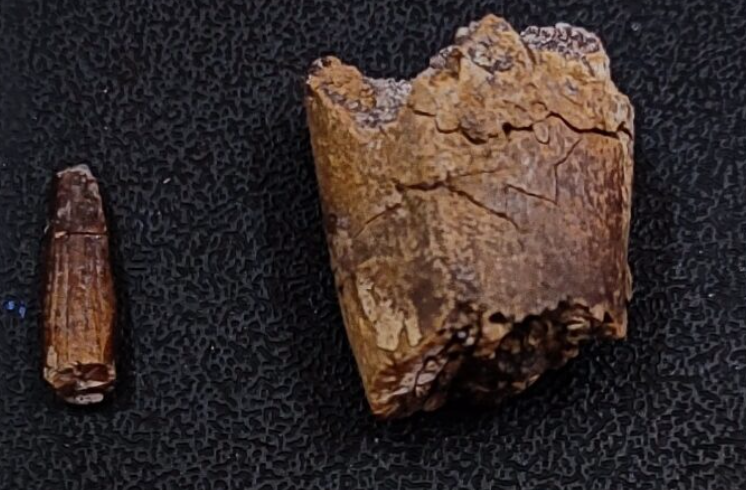
Scientists from the Palaeontology Division of the Geological Survey of India (GSI), North Eastern Region, Shillong, discovered two fossilised teeth of Titanosaurian sauropods at Mawphuli village near Ranikor in South West Khasi Hills, Meghalaya. This is the first-ever discovery of dinosaur teeth in Northeast India, providing crucial evidence that Meghalaya was once inhabited by long-necked dinosaurs during the Late Cretaceous period.
Key Highlights
Discovery
- Location: Mawphuli village near Ranikor, South West Khasi Hills, Meghalaya.
- Discovering Agency: Geological Survey of India (GSI), Palaeontology Division, Shillong.
- Field Season: 2023–24.
- Date of Discovery: 8 January 2024 (officially announced after scientific procedures).
About the Fossils
- Two fossilised teeth belonging to Titanosaurian sauropods were recovered.
- Preserved in the Mahadek Formation of the Khasi Group.
- Geological Age:
- Upper Cretaceous (Maastrichtian Stage)
- Approximately 72.1–66 million years old.
- Similar fossils have previously been reported from:
- Argentina
- Morocco
- Uzbekistan
- Australia.
About Titanosaurian Sauropods
- Titanosaurs were among the largest land animals ever to exist.
- Characteristics:
- Long neck
- Long tail
- Small head
- Pillar-like legs
- Herbivorous diet
- They belonged to the Sauropoda group.
- They became extinct during the Cretaceous–Paleogene (K–Pg) mass extinction around 66 million years ago, likely following the Chicxulub asteroid impact.
Geological Importance
The discovery:
- Represents the first dinosaur teeth discovered in Northeast India.
- Strengthens evidence that dinosaurs once inhabited Meghalaya.
- Helps bridge gaps in the fossil record of Indian titanosaurs.
- Improves understanding of dinosaur distribution during the Late Cretaceous.
- Indicates that Meghalaya formed part of suitable terrestrial habitats for giant herbivorous dinosaurs.
Earlier Dinosaur Discoveries in Meghalaya
1977
- Fragmentary vertebrate fossils reported near Nongnah.
2001
- Fossils confirmed as dinosaur bones.
2006–07
- Additional dinosaur bone fragments discovered.
2019–21
- Limb bones comparable to Titanosaurs recovered from Dirang and Mawphuli.
2024
- First-ever dinosaur teeth discovered in Northeast India.
Mahadek Formation
The Mahadek Formation is:
- A geological formation of the Khasi Group.
- Located mainly in Meghalaya.
- Composed predominantly of sandstones.
- Deposited during the Upper Cretaceous.
- Rich in vertebrate fossils, making it significant for Indian palaeontology.
Geological Survey of India (GSI)
Established
- 1851
Headquarters
- Kolkata
Ministry
- Ministry of Mines
Functions
- Geological mapping.
- Mineral exploration.
- Fossil and palaeontological research.
- Natural hazard studies.
- Groundwater and geotechnical investigations.
- Geoheritage conservation.
The North Eastern Region Headquarters is located in Shillong, Meghalaya.
Significance for Meghalaya
- Meghalaya is emerging as an important dinosaur fossil site in India.
- Enhances the state’s importance in palaeontological and geological research.
- Opens opportunities for:
- Geo-tourism
- Scientific research
- Museum development
- Educational tourism
source: Meghalaya monitor
Practice Questions
Q1. The recently discovered dinosaur teeth in Meghalaya belong to which group?
(A) Theropods
(B) Ceratopsians
(C) Titanosaurian Sauropods
(D) Ornithopods
Answer: (C)
Q2. The dinosaur teeth discovered in Meghalaya were found in which geological formation?
(A) Lameta Formation
(B) Mahadek Formation
(C) Vindhyan Formation
(D) Gondwana Formation
Answer: (B)
Q3. The Geological Survey of India functions under which ministry?
(A) Ministry of Earth Sciences
(B) Ministry of Mines
(C) Ministry of Science & Technology
(D) Ministry of Environment, Forest and Climate Change
Answer: (B)
Q4. Which statement is correct regarding Titanosaurs?
- They were herbivorous dinosaurs.
- They had long necks and long tails.
- They survived until the Ice Age.
Select the correct answer:
(A) 1 only
(B) 1 and 2 only
(C) 2 and 3 only
(D) 1, 2 and 3
Answer: (B)
Q5. The Mahadek Formation of Meghalaya belongs to which geological period?
(A) Jurassic
(B) Triassic
(C) Upper Cretaceous
(D) Paleogene
Answer: (C)