

Why in News?
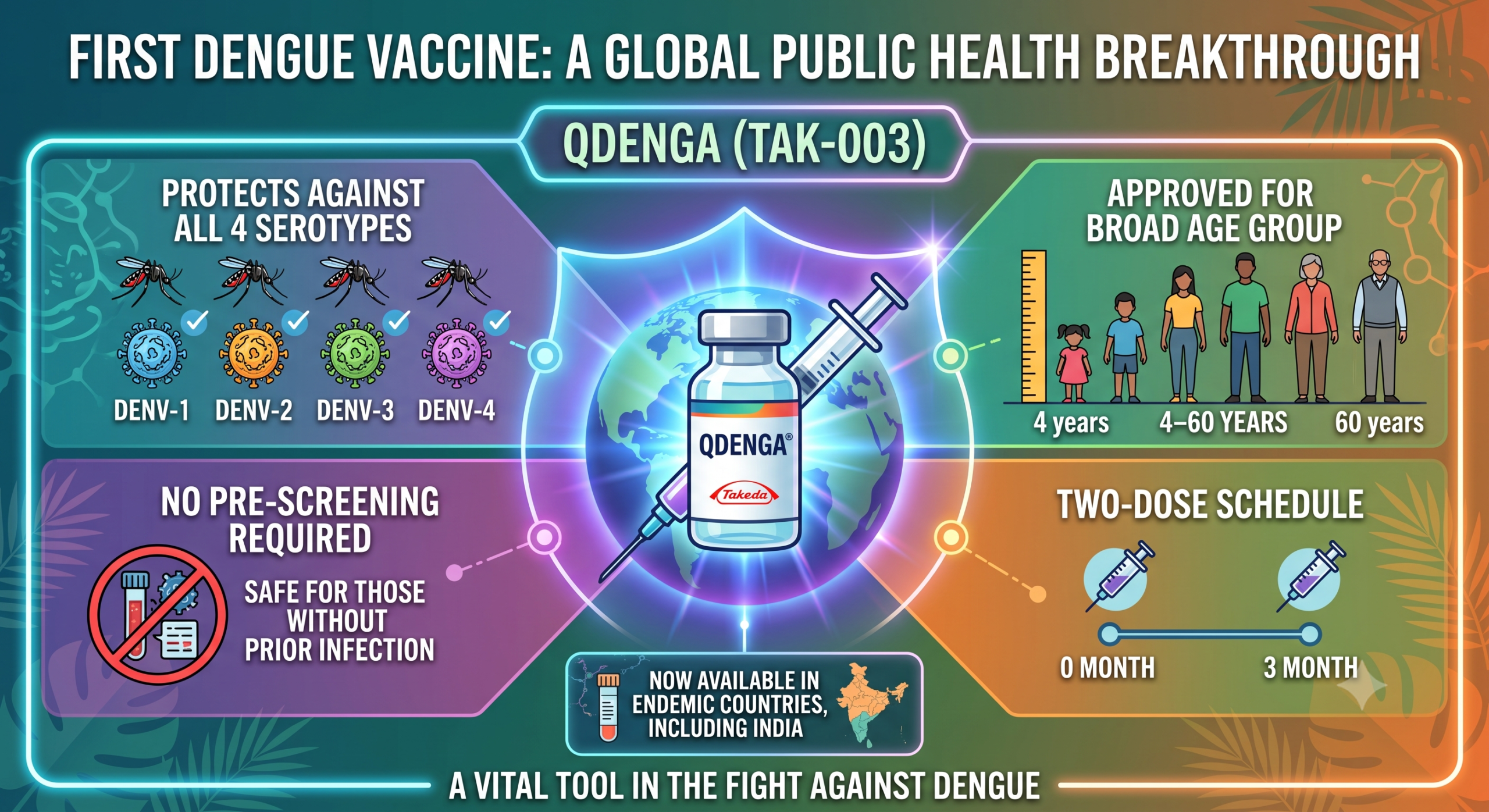
India has approved QDENGA (TAK-003) as its first approved dengue vaccine. The Drug Controller General of India (DCGI) has granted market authorisation for the vaccine, marking a major milestone in India’s fight against dengue.
Key Highlights
- Vaccine Name: QDENGA (TAK-003)
- Developer: Takeda Biopharmaceuticals (Japan)
- Approved by: Drug Controller General of India (DCGI)
- Approval Year: 2026
- Eligible Age Group: 4–60 years
- Type: Live attenuated tetravalent dengue vaccine
- Number of Doses: 2 doses
- Interval: 3 months between doses
- Pre-vaccination dengue testing: Not required.
What is QDENGA?
QDENGA is a live attenuated (weakened) tetravalent vaccine that provides protection against all four serotypes of the dengue virus (DENV-1, DENV-2, DENV-3, and DENV-4).
It is designed to reduce:
- Symptomatic dengue infection
- Severe dengue
- Dengue-related hospitalisation.
Why is it Significant?
- First approved dengue vaccine in India.
- Offers protection against all four dengue virus serotypes.
- Can be administered irrespective of previous dengue infection.
- Expected to reduce severe illness and hospital admissions.
- Strengthens India’s public health response to increasing dengue cases.
About Dengue
- Cause: Dengue virus (Flavivirus)
- Vector: Female Aedes aegypti mosquito (also Aedes albopictus)
- Transmission: Mosquito bite
- Virus Serotypes: DENV-1, DENV-2, DENV-3 and DENV-4
Common Symptoms
- High fever
- Severe headache
- Pain behind the eyes
- Muscle and joint pain
- Skin rash
- Nausea and vomiting
Severe Dengue
May cause:
- Internal bleeding
- Plasma leakage
- Organ failure
- Shock (Dengue Shock Syndrome)
Why is a Dengue Vaccine Difficult to Develop?
- Dengue has four different serotypes.
- Infection with one serotype gives lifelong immunity only against that serotype.
- A second infection with another serotype can increase the risk of severe disease due to Antibody-Dependent Enhancement (ADE).
- Therefore, a vaccine must provide balanced protection against all four serotypes.
Effectiveness
Clinical studies showed that QDENGA:
- Reduced laboratory-confirmed dengue infections by about 80%.
- Reduced dengue-related hospitalisation by over 90%.
Important Points for Exams
- India’s first approved dengue vaccine: QDENGA (TAK-003)
- Developer: Takeda (Japan)
- Approved by: DCGI
- Age group: 4–60 years
- Schedule: Two doses, three months apart
- Protects against: DENV-1, DENV-2, DENV-3 and DENV-4
- Type: Live attenuated tetravalent vaccine
- Vector of dengue: Female Aedes aegypti mosquito
- Testing before vaccination: Not required
Practice MCQs
1. QDENGA, recently seen in the news, is related to:
- (A) Malaria
- (B) Dengue
- (C) Chikungunya
- (D) Japanese Encephalitis
Answer: (B)
2. QDENGA protects against:
- (A) One dengue virus serotype
- (B) Two dengue virus serotypes
- (C) Three dengue virus serotypes
- (D) Four dengue virus serotypes
Answer: (D)
3. QDENGA was developed by:
- (A) Bharat Biotech
- (B) Serum Institute of India
- (C) Takeda Biopharmaceuticals
- (D) Moderna
Answer: (C)
4. Dengue is transmitted by:
- (A) Anopheles mosquito
- (B) Culex mosquito
- (C) Female Aedes aegypti mosquito
- (D) Sandfly
Answer: (C)