

INTRODUCTION TO COMPUTERS
What is a computer?
A computer is an electronic machine or device that performs processes, calculations, and operations based on instructions provided by software or hardware programs. It is designed to execute applications and provide a variety of solutions by combining integrated hardware and software components.
The word Computer is derived from the Latin word “Computare”, which means “to calculate.”
FATHER OF COMPUTER: Charles Babbage is known as the Father of the Computer.
He designed:
- Difference Engine
- Analytical Engine
The Analytical Engine is considered an important foundation of the modern general-purpose computer.
Key Facts
| Person | Known As |
| Charles Babbage | Father of Computer |
| Ada Lovelace | First Computer Programmer |
| Alan Turing | Father of Theoretical Computer Science / Artificial Intelligence |
| John von Neumann | Father of Modern Computer Architecture |
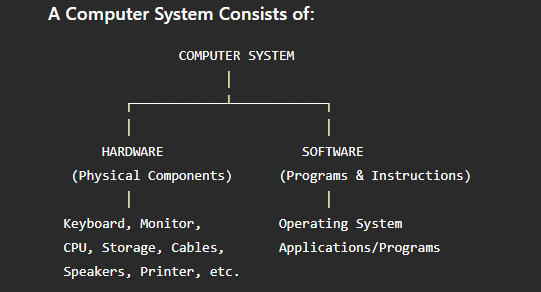
1. Hardware
Hardware refers to the physical components and equipment of a computer that can be seen and touched.
Examples: Computer Case, Storage Devices, Keyboard, Monitor, Cables, Speakers, Printer
2. Software
Software refers to the operating systems and programs that provide instructions to the computer.
Software can be broadly classified into:
- Operating System: Instructs and controls the computer on how to operate.
- Programs or Applications: Perform different functions according to the user’s requirements.
Note: The commonly used expansion of COMPUTER is:
Common Operating Machine Purposely Used for Technological and Educational Research.
However, this is a backronym and not the official origin of the word “computer.”
INFORMATION PROCESSING CYCLE
The Information Processing Cycle is a series of processes involved in handling information. It generally includes input, processing, output, and storage. These processes work together and are repeated continuously.
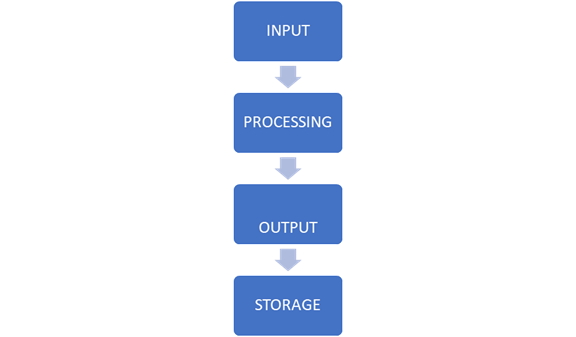
└──────► Data may be used again
1. Input: It is the process of entering raw data and instructions into a computer.
Examples: Keyboard, mouse, scanner, microphone.
2. Processing: It is the operation performed by the computer on the input data according to the given instructions.
3. Output: It is the result produced after the computer processes the input data.
Examples: Information displayed on a monitor, printed documents, or sound from speakers.
4. Storage: It is the process of saving data, programs, or output for future use.
Basic Working of a Computer
A computer is an electronic device that:
- Accepts raw data (unprocessed data) as input from the user.
- Processes the data under the control of a set of instructions called a program.
- Produces the processed result as output.
- Stores the data or result for future use.
Practice Questions
1. The word “Computer” is derived from which Latin word?
(A) Computare
(B) Computus
(C) Computation
(D) Computeris
Answer: (A) Computare
Explanation: The word Computer is derived from the Latin word “Computare,” which means “to calculate.”
2. Which of the following is the basic working cycle of a computer?
(A) Input → Output → Process
(B) Process → Input → Output
(C) Input → Process → Output
(D) Output → Input → Process
Answer: (C) Input → Process → Output
Explanation: A computer follows the IPO Cycle: Input → Processing → Output.
3. Who among the following is known as the ‘Father of Modern Computer’?
A. Bill Gates
B. Mark Zuckerberg
C. Herman Hollerith
D. Charles Babbage
Data Entry Operator 2024 / Field Assistant 2024
Answer: D. Charles Babbage
Explanation: Charles Babbage, a mathematician, philosopher, and mechanical engineer, originated the concept of a digital programmable computer
4. A computer is primarily a machine that processes:
(A) Instructions only
(B) Data
(C) Electricity only
(D) Programs only
Answer: (B) Data
Explanation: A computer accepts data as input, processes it according to instructions, and produces meaningful information as output.
5. The basic architecture of computer was developed by
- Charles Babbage
- John von Neumann
- Gordon Moore
- Blaise Pascal
Assistant Director of Survey
Answer: John von Neumann
Explanation: The von Neumann architecture is a computer architecture based on the 1945 description by mathematician and physicist John von Neumann, outlining a system containing a processing unit, control unit, memory, mass storage, and input/output mechanisms.
Kindly provide me notes