

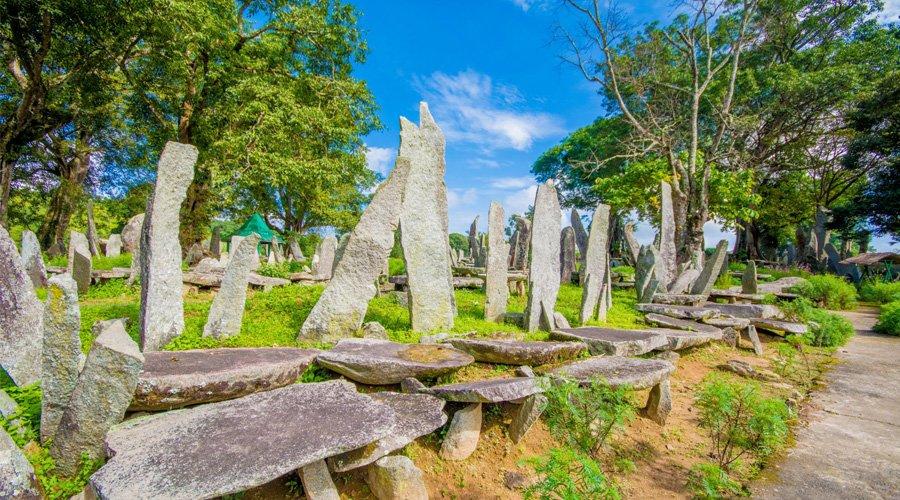
The Nartiang Monoliths are a megalithic site located in Nartiang village, Meghalaya’s West Jaintia Hills district, about 24 km from Jowai and 60 km east of Shillong. They comprise the largest single cluster of monoliths in the Khasi–Jaintia Hills, dating between the 16th and 19th centuries. The site is protected as a Monument of National Importance under India’s 1958 heritage law.
Key facts
- Location: Law Mulong area, Nartiang village, West Jaintia Hills
- Period: ca. 1500 – 1835 CE
- Structure types: Menhirs (upright stones) and dolmens (flat stones)
- Tallest stone: Moo Iong Syiem, ~8 m high
- Heritage status: Declared national monument (1958)
Historical background
The monoliths were erected by Jaintia kings and clans to honor ancestors, commemorate victories, and mark royal or communal events. Nartiang served as the summer capital of the Jaintia kingdom. U Mar Phalyngki, a royal lieutenant, raised the tallest menhir to celebrate a military victory. Other stones were installed by leaders such as U Luh Lyngskor Lamare and local clans, forming a symbolic “garden of monoliths.”
Cultural and symbolic meaning
Locally, upright stones—Ki Moo Shynrang—represent male ancestors or warriors, while horizontal slabs—Ki Moo Kynthai—honor female lineages. Together they embody the matrilineal heritage of the Jaintia people. The site also reflects older spiritual practices linked to the pre-Christian Niamtre faith and, later, Hindu influences visible at the nearby Nartiang Durga Temple.
Architecture and layout


Spread over roughly 100 m in diameter north of the Nartiang market, the complex includes hundreds of upright and flat stones placed without mortar. The engineering precision suggests advanced local knowledge of stone selection and placement. Some stones reach up to 26 ft (8 m) in height and weigh several tons.
Visiting information
Nartiang is accessible by road from Jowai (≈ 25 km) and Shillong (≈ 65 km). The nearest airport is Umroi Airport near Umiam Lake. Entry is free, and the best visiting season is October–March, when weather is cool and dry. Visitors often pair the site with the 500-year-old Durga Temple, Thadlaskein Lake, or Krang Suri Falls.
Legacy and preservation
Managed by the Archaeological Survey of India with community support, the Nartiang Monoliths continue to be a living cultural landmark. They stand as enduring symbols of the Jaintia civilization’s social structure, craftsmanship, and reverence for ancestry—earning Nartiang the nickname “Stonehenge of the Northeast.”
1 thought on “Nartiang Monoliths”