

National Family Health Survey (NFHS-6)
Why in News?
The Ministry of Health and Family Welfare (MoHFW) released the preliminary findings of the Sixth National Family Health Survey (NFHS-6) on May 29, 2026. Coordinated exclusively by the International Institute for Population Sciences (IIPS), Mumbai, this round represents a historic shift as it was executed entirely without external financial or technical help. The survey covered nearly 6.79 lakh households across 715 districts between 2023–24.
Meghalaya State Key Highlights & Trends
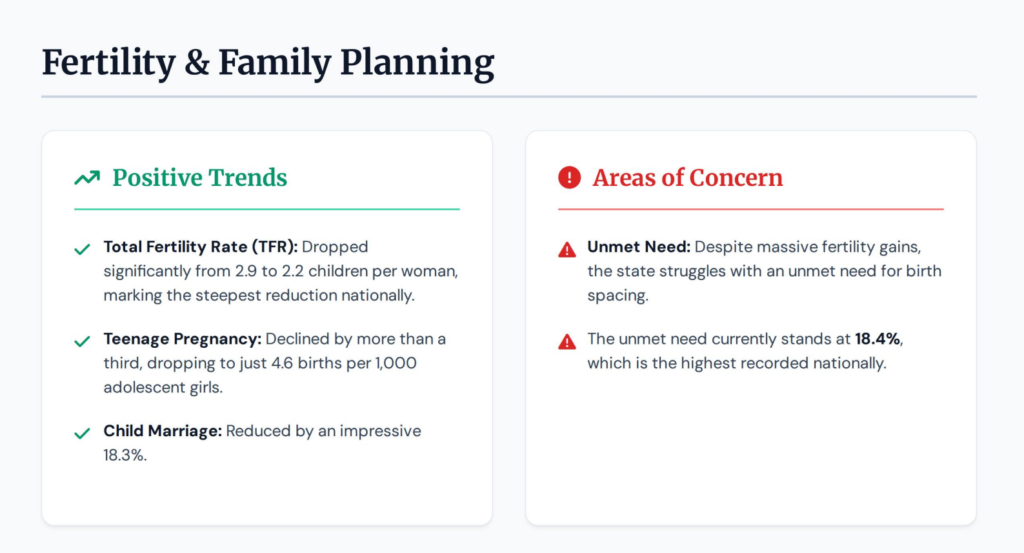
Fertility & Family Planning
Positive:
- Total Fertility Rate (TFR): Dropped significantly from 2.9 to 2.2 children per woman (steepest reduction nationally).
- Teenage Pregnancy: Declined by more than a third, dropping to 4.6 births per 1,000 adolescent girls.
- Child Marriage: Reduced by 18.3%.
Negative:
- Unmet Need: The state has the highest unmet need for birth spacing in the country, standing at 18.4%.
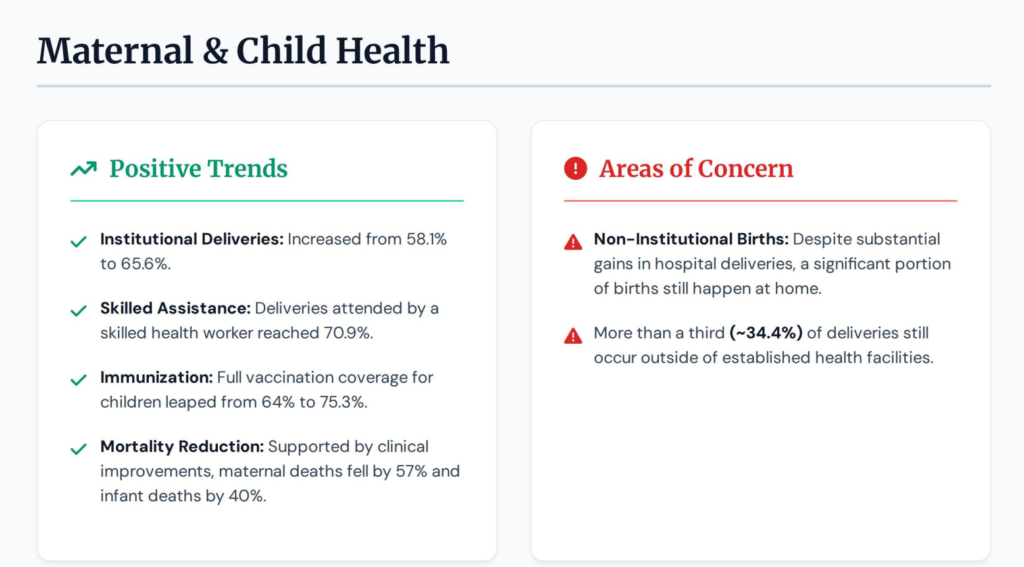
Maternal & Child Health
Positive:
- Institutional Deliveries: Increased from 58.1% to 65.6%.
- Skilled Birth Attendance: Deliveries attended by skilled health workers reached 70.9%.
- Child Immunization: Full vaccination coverage leaped from 64% to 75.3% (one of India’s fastest gains).
- Mortality: Maternal deaths fell by 57% and infant deaths by 40% over the last five years.
Negative:
- Non-Institutional Births: Despite gains, more than a third (~34.4%) of deliveries still occur outside of health facilities.
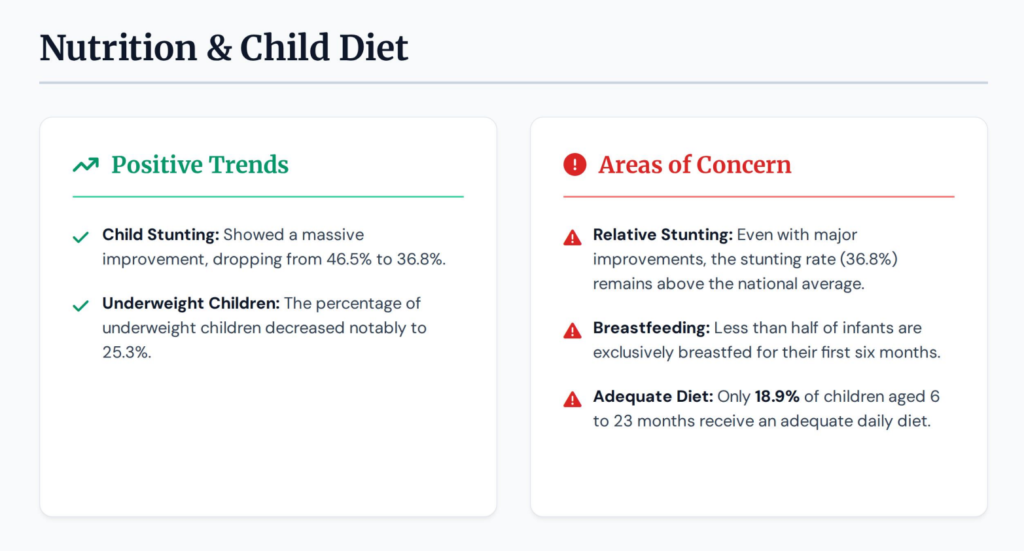
Nutrition & Child Diet
Positive:
- Child Stunting: Showed massive improvement, dropping from 46.5% to 36.8%.
- Underweight Children: Decreased to 25.3%.
Negative:
- Relative Stunting Levels: Even with the improvements, the stunting rate (36.8%) remains above the national average.
- Breastfeeding: Less than half of infants are exclusively breastfed for their first six months.
- Child Diet: Only 18.9% of children aged 6 to 23 months receive an adequate daily diet.
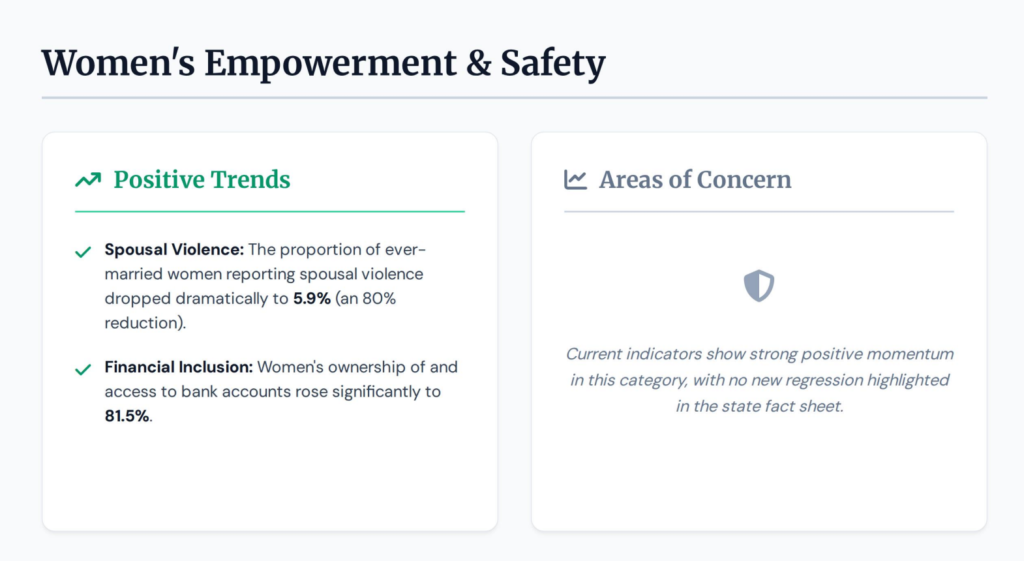
Women’s Empowerment & Safety
Positive:
- Spousal Violence: Dropped by 80% to just 5.9% of ever-married women.
- Financial Inclusion: Women’s ownership of bank accounts rose to 81.5%.
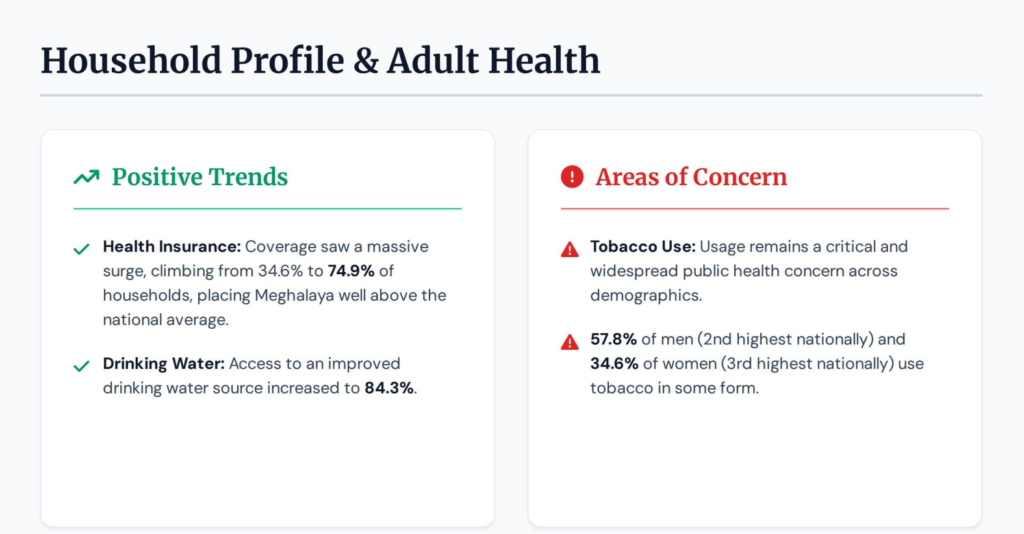
Household Profile & Adult Health
Positive:
- Health Insurance: Coverage surged from 34.6% to 74.9% of households, well above the national average.
- Drinking Water: Access to an improved drinking water source increased to 84.3%.
Negative:Tobacco Use: Extremely high usage rates remain a critical public health issue, with 57.8% of men (2nd highest nationally) and 34.6% of women (3rd highest nationally) using tobacco
Way Forward & Policy Recommendations for Meghalaya
To leverage the findings of NFHS-6 and correct local demographic distress, the Government of Meghalaya can adopt the following multi-pronged approach:
- Strengthening the MOTHER App
- Addressing Topography-Induced Gaps
- Dietary Diversification
- Improvement of Digital Literacy
Practice Question for MPSC
Q. Consider the following statements regarding the recently released National Family Health Survey (NFHS-6):
- The survey was financially and technically supported heavily by international agencies.
- The Total Fertility Rate (TFR) of India has dropped below the replacement level of 2.1.
- For the first time, universal screening for Hepatitis-B and Hepatitis-C was introduced.
Which of the statements given above are correct?
A) 1 and 2 only
B) 2 and 3 only
C) 1 and 3 only
D) 1, 2 and 3
Mains Analytical Question
Q. “While India has made significant strides in institutional healthcare and digital inclusion as per the NFHS-6, regional disparities and data-tracking gaps pose a policy challenge.” Evaluate this statement with special reference to the socio-economic and geographical realities of Meghalaya. (15 Marks, 250 Words)