

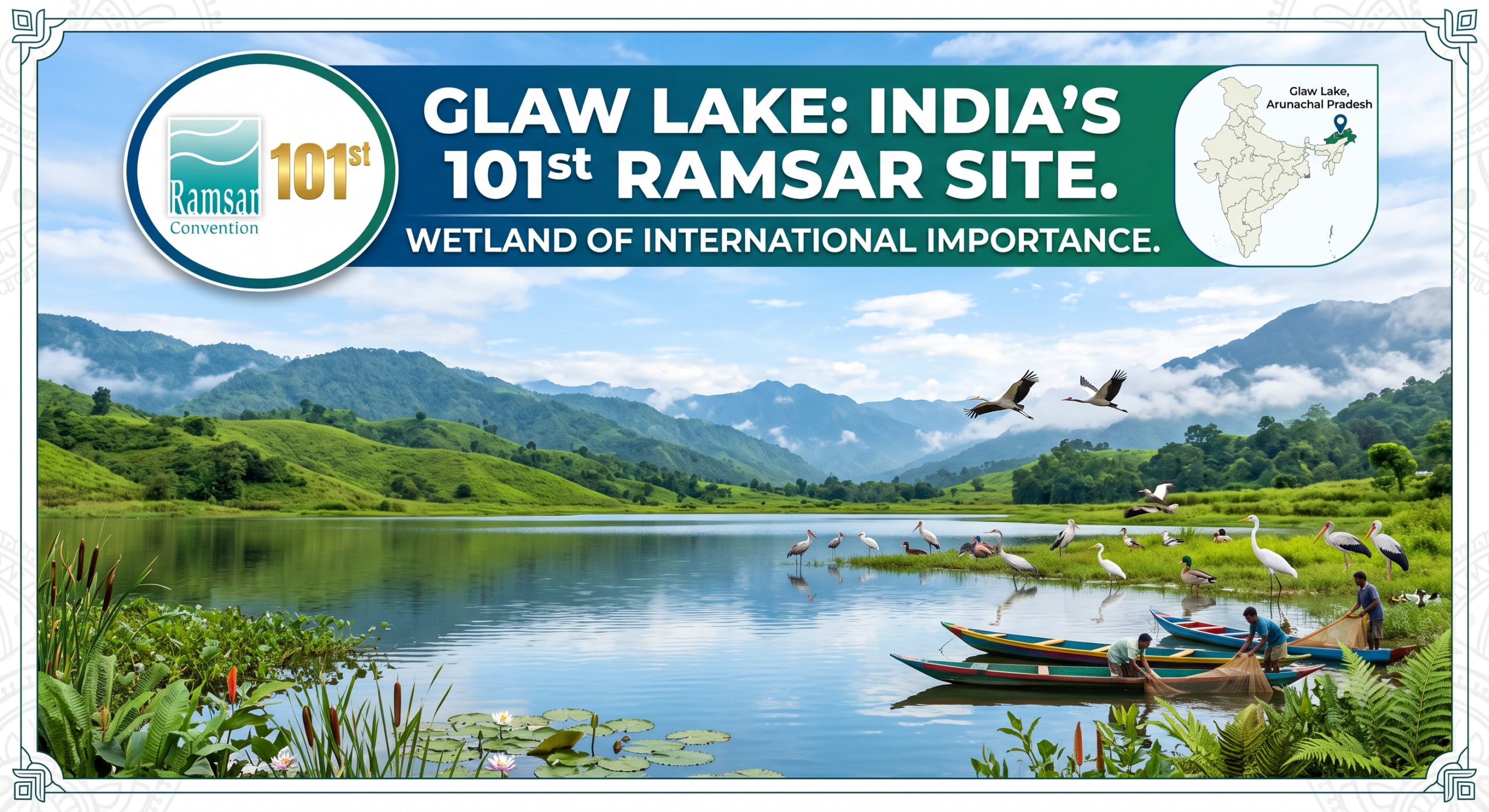
In a significant milestone for wetland conservation, Glaw Lake in Arunachal Pradesh has been officially designated as India’s 101st Ramsar Site under the Ramsar Convention on Wetlands. The announcement was made by Union Minister for Environment, Forest and Climate Change, Bhupender Yadav, making Glaw Lake the first Ramsar Site in Arunachal Pradesh.
The designation recognises the lake’s outstanding ecological value and reinforces India’s commitment to biodiversity conservation, climate resilience, and sustainable management of wetlands.
What is a Ramsar Site?
A Ramsar Site is a wetland designated as a Wetland of International Importance under the Ramsar Convention, an international treaty adopted in 1971 at Ramsar, Iran. The Convention aims to conserve wetlands and promote their wise and sustainable use through national action and international cooperation.
India became a Contracting Party to the Ramsar Convention in 1982.
About Glaw Lake
Glaw Lake is a pristine freshwater lake located in the Lohit district of Arunachal Pradesh, within the Kamlang Tiger Reserve and Wildlife Sanctuary in the Eastern Himalayas.
Key Features
- Location: Lohit district, Arunachal Pradesh
- Protected Area: Kamlang Tiger Reserve and Wildlife Sanctuary
- Type: Freshwater lake
- River Nearby: Kamlang River
- Status: Important Bird and Biodiversity Area (IBA)
- Ramsar Designation: India’s 101st Ramsar Site and Arunachal Pradesh’s first Ramsar Site.
Ecological Importance
Glaw Lake lies within one of the world’s richest biodiversity regions—the Eastern Himalaya Biodiversity Hotspot.
The wetland supports diverse flora and fauna, including:
- Tiger
- Leopard
- Clouded Leopard
- Snow Leopard
- Hoolock Gibbon
- Hornbills
- Numerous migratory and resident bird species
The surrounding forests contain rich plant diversity, including over 150 tree species and 49 orchid species, making the area ecologically significant.
Why is Ramsar Recognition Important?
The Ramsar designation helps to:
- Promote conservation of wetlands.
- Protect biodiversity and endangered species.
- Improve water security.
- Enhance climate resilience through ecosystem conservation.
- Encourage sustainable livelihoods for local communities.
- Strengthen eco-tourism and environmental awareness.
Although Ramsar designation does not automatically create a protected area, it encourages governments to adopt better management and conservation practices.
India’s Ramsar Sites
With the inclusion of Glaw Lake:
- India now has 101 Ramsar Sites.
- Arunachal Pradesh has received its first Ramsar Site.
- India has significantly expanded its network of internationally recognised wetlands in recent years, reflecting increased emphasis on wetland conservation.
Practice MCQs
1. Glaw Lake, recently designated as India’s 101st Ramsar Site, is located in:
A. Assam
B. Meghalaya
C. Arunachal Pradesh
D. Sikkim
Answer: C
Explanation: Glaw Lake is situated in the Lohit district of Arunachal Pradesh and is the state’s first Ramsar Site.
2. The Ramsar Convention was adopted in:
A. 1968
B. 1971
C. 1975
D. 1982
Answer: B
Explanation: The Ramsar Convention was adopted in 1971 at Ramsar, Iran.
3. Glaw Lake is situated within which protected area?
A. Namdapha National Park
B. Dibru-Saikhowa National Park
C. Kamlang Tiger Reserve and Wildlife Sanctuary
D. Pakke Tiger Reserve
Answer: C
Explanation: Glaw Lake lies within the Kamlang Tiger Reserve and Wildlife Sanctuary in Arunachal Pradesh.
4. India became a Contracting Party to the Ramsar Convention in:
A. 1971
B. 1975
C. 1982
D. 1992
Answer: C
Explanation: India joined the Ramsar Convention in 1982.
5. Which of the following statements is correct regarding Glaw Lake?
A. It is India’s first Ramsar Site.
B. It is a saline lake in Rajasthan.
C. It is the first Ramsar Site in Arunachal Pradesh.
D. It is located in the Western Ghats.
Answer: C
Explanation: Glaw Lake is the first Ramsar Site in Arunachal Pradesh and India’s 101st Ramsar Site.
Exam Facts to Remember
| Topic | Fact |
|---|---|
| Latest Ramsar Site | Glaw Lake |
| Ramsar Number | 101st in India |
| State | Arunachal Pradesh |
| District | Lohit |
| Protected Area | Kamlang Tiger Reserve and Wildlife Sanctuary |
| Type | Freshwater Lake |
| River | Kamlang River |
| Biodiversity Status | Important Bird and Biodiversity Area (IBA) |
| Biodiversity Hotspot | Eastern Himalayas |
| Ramsar Convention | Adopted in 1971 at Ramsar, Iran |
| India Joined Ramsar Convention | 1982 |
| Union Minister Announcing Designation | Bhupender Yadav |