

Source: The Shillongtimes
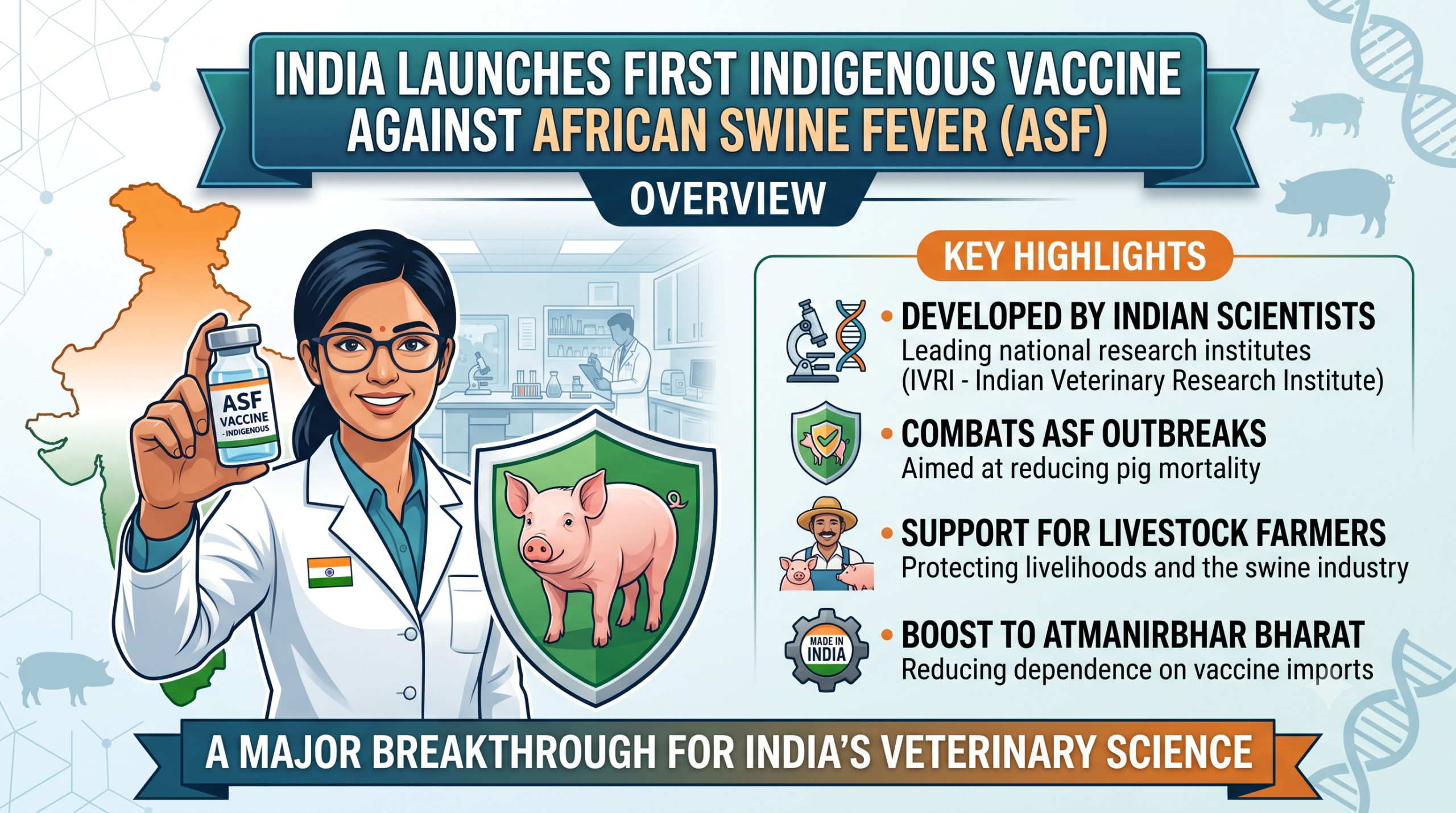
In a major breakthrough for India’s livestock sector, the Government of India has launched the country’s first indigenous vaccine against African Swine Fever (ASF), offering new hope to pig farmers, especially in the Northeastern states where pig farming is an important source of livelihood and food security.
The announcement was made by Union Minister for Agriculture and Farmers’ Welfare, Shivraj Singh Chouhan. The vaccine has been developed by the ICAR–National Institute of High Security Animal Diseases (ICAR-NIHSAD), Bhopal, under the Indian Council of Agricultural Research (ICAR).
The development is expected to significantly reduce the devastating impact of ASF, which has caused massive economic losses since the disease was first detected in India in 2020.
What is African Swine Fever (ASF)?
African Swine Fever (ASF) is a highly contagious viral disease affecting domestic and wild pigs. It is caused by the African Swine Fever Virus (ASFV) and is characterised by extremely high mortality, often reaching 100% in infected animals.
Although ASF is deadly for pigs, it does not infect humans and poses no food safety risk to people consuming properly cooked pork.
There is no effective treatment for ASF, making vaccination and biosecurity the most effective methods of disease control.
Impact on Northeast India
The Northeast has been the worst-affected region because pig farming plays a central role in rural livelihoods and dietary habits.
Since the outbreak:
- Thousands of pigs have been culled.
- Farmers have suffered severe income losses.
- Pork prices have increased due to reduced supply.
- Rural livelihoods have been adversely affected.
According to available estimates:
- Mizoram has recorded losses of nearly ₹982 crore, affecting more than 11,300 households.
- Assam has suffered estimated losses of around ₹276 crore.
- Meghalaya has also witnessed repeated ASF outbreaks, disrupting pig farming across several districts.
Features of the Indigenous Vaccine
The new vaccine is India’s first live-attenuated ASF vaccine.
Key Features
- Developed by ICAR-NIHSAD, Bhopal.
- Uses the MA-104 cell line, which is widely available.
- Cheaper to manufacture than imported vaccines.
- Suitable for large-scale production.
- Designed for pigs older than eight weeks.
- Administered as a 1 mL intramuscular injection.
- Booster dose required 14 days after the first dose.
- Successfully completed laboratory and field validation trials.
Why is the Vaccine Significant?
The vaccine is expected to:
- Reduce mortality among pigs.
- Minimise the need for mass culling.
- Protect the livelihood of pig farmers.
- Improve pork production and supply.
- Strengthen India’s livestock health system.
- Enhance food and nutritional security in the Northeast.
- Reduce dependence on imported vaccines.
Challenges Ahead
Despite this scientific achievement, successful implementation will depend on:
- Efficient cold-chain infrastructure.
- Timely vaccine distribution.
- Awareness among farmers.
- Veterinary support in remote villages.
- Adequate vaccination coverage before seasonal outbreaks.
For Meghalaya, where many rural households depend on pig farming, effective vaccine delivery could significantly improve economic resilience.
Practice MCQs
1. India’s first indigenous vaccine against African Swine Fever (ASF) has been developed by:
A. Indian Veterinary Research Institute (IVRI)
B. ICAR–National Institute of High Security Animal Diseases (ICAR-NIHSAD), Bhopal
C. National Dairy Development Board (NDDB)
D. National Centre for Disease Control (NCDC)
Answer: B
Explanation: The vaccine was developed by scientists at ICAR–NIHSAD, Bhopal, under the Indian Council of Agricultural Research (ICAR).
2. African Swine Fever (ASF) primarily affects:
A. Cattle
B. Poultry
C. Pigs
D. Goats
Answer: C
Explanation: ASF is a highly contagious viral disease affecting domestic and wild pigs.
3. Which of the following statements regarding African Swine Fever is correct?
A. It spreads to humans through pork consumption.
B. It is caused by a bacterium.
C. It affects pigs but does not infect humans.
D. It mainly affects poultry.
Answer: C
Explanation: ASF affects only pigs and is not a zoonotic disease.
4. The indigenous ASF vaccine uses which cell line for production?
A. HeLa Cell Line
B. MA-104 Cell Line
C. Vero Cell Line
D. CHO Cell Line
Answer: B
Explanation: The vaccine utilises the MA-104 cell line, making production more affordable and scalable.
5. Why is the indigenous ASF vaccine particularly significant for Meghalaya and other Northeastern states?
A. It promotes dairy farming.
B. It increases poultry exports.
C. It protects pig farming, an important source of livelihood and food security.
D. It improves rice production.
Answer: C
Explanation: Pig farming is a major source of income and nutrition in Northeast India. The vaccine is expected to reduce losses from ASF and strengthen rural livelihoods.
MCS Prelims Facts to Remember
| Topic | Fact |
|---|---|
| Disease | African Swine Fever (ASF) |
| Affected Animals | Domestic and wild pigs |
| Causative Agent | African Swine Fever Virus (ASFV) |
| Human Infection | Does not infect humans |
| Mortality Rate | Up to 100% in pigs |
| First Reported in India | 2020 |
| Vaccine Developer | ICAR–NIHSAD, Bhopal |
| Parent Organisation | Indian Council of Agricultural Research (ICAR) |
| Vaccine Type | Live-attenuated vaccine |
| Cell Line Used | MA-104 |
| Eligible Animals | Healthy pigs above 8 weeks of age |
| Administration | 1 mL intramuscular injection + booster after 14 days |
| Announcement | Union Agriculture Minister Shivraj Singh Chouhan |
Mains Perspective
The launch of India’s first indigenous African Swine Fever vaccine demonstrates the growing role of scientific research in addressing agricultural and livestock challenges. For the Northeastern states, where pig farming is closely linked to rural livelihoods, nutrition, and cultural practices, the vaccine has the potential to reduce economic losses, strengthen food security, and enhance the resilience of smallholder farmers. The initiative also reflects India’s progress in achieving self-reliance in animal health technologies and promoting sustainable livestock development.