

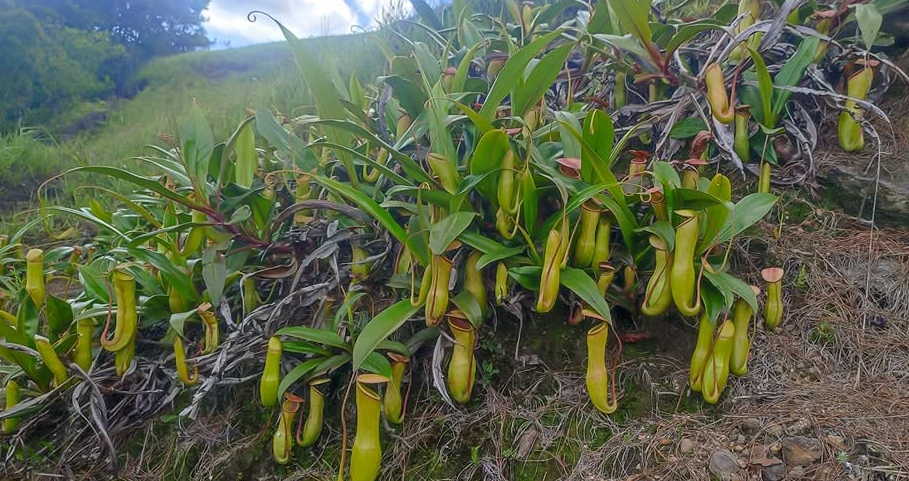
Meghalaya’s Rare Pitcher Plant Has a Favourite Address: Northwest-Facing Hillsides
Why in News?
A recent scientific study on Nepenthes khasiana, India’s only native pitcher plant, has revealed that the endangered species shows a strong preference for northwest-facing hillsides, highlighting the importance of microhabitats in its conservation. The findings also emphasize that soil health is as important as insect prey for the plant’s survival.
About Nepenthes khasiana
- It is India’s only native carnivorous pitcher plant.
- Endemic mainly to the Khasi, Jaintia and Garo Hills of Meghalaya, with a few isolated populations in neighbouring regions.
- Listed as Endangered on the IUCN Red List and included under CITES Appendix I, making international commercial trade highly restricted.
Key Findings of the Study
- The plant predominantly grows on northwest-facing slopes, where environmental conditions such as moisture, temperature, and sunlight are more favourable.
- Researchers found that nutrient-rich soil and healthy microbial communities play a crucial role in the plant’s growth, in addition to nutrients obtained from trapped insects.
- The Jaintia Hills have emerged as an important refuge for the species due to favourable habitat conditions.
Why is the Pitcher Plant Carnivorous?
- It grows in nutrient-poor, acidic soils.
- To compensate for nitrogen deficiency, it traps insects using modified leaf structures called pitchers.
- Digestive enzymes inside the pitcher break down prey, allowing the plant to absorb essential nutrients.
Threats
- Habitat destruction due to mining, road construction, and shifting land use.
- Illegal collection for ornamental trade.
- Climate change affecting suitable microhabitats.
- Forest degradation and human disturbances.
Conservation Measures
- Protection through the Baghmara Pitcher Plant Wildlife Sanctuary in Meghalaya.
- Tissue culture and ex-situ conservation programmes.
- Habitat restoration and community participation.
- Scientific monitoring of microhabitats and soil conditions.
Importance for Meghalaya
- A unique component of Meghalaya’s biodiversity and ecological heritage.
- Supports eco-tourism and scientific research.
- Highlights the need for landscape-level conservation based on habitat characteristics rather than only species protection.
Practice MCQs
Q1. Nepenthes khasiana is significant because it is:
A. India’s only native carnivorous pitcher plant
B. The tallest flowering plant in India
C. A medicinal plant found only in the Western Ghats
D. A mangrove species endemic to the Sundarbans
Answer: A
Q2. The primary reason pitcher plants trap insects is to:
A. Protect themselves from predators
B. Obtain nutrients, especially nitrogen, from nutrient-poor soils
C. Aid in seed dispersal
D. Increase pollination
Answer: B
Q3. Which of the following statements is/are correct?
- Nepenthes khasiana is endemic mainly to Meghalaya.
- Recent research indicates that the species prefers northwest-facing hillsides.
- Soil quality has little influence on the survival of the species.
Select the correct answer:
A. 1 and 2 only
B. 2 and 3 only
C. 1 and 3 only
D. 1, 2 and 3
Answer: A
Mains Practice Question
Q. Discuss the ecological significance of Nepenthes khasiana and explain how recent scientific findings on its habitat preferences can improve biodiversity conservation strategies in Meghalaya. (150 words)