

For Meghalaya Civil Service (MCS), Meghalaya GK, & other competitive examinations
Why in News?
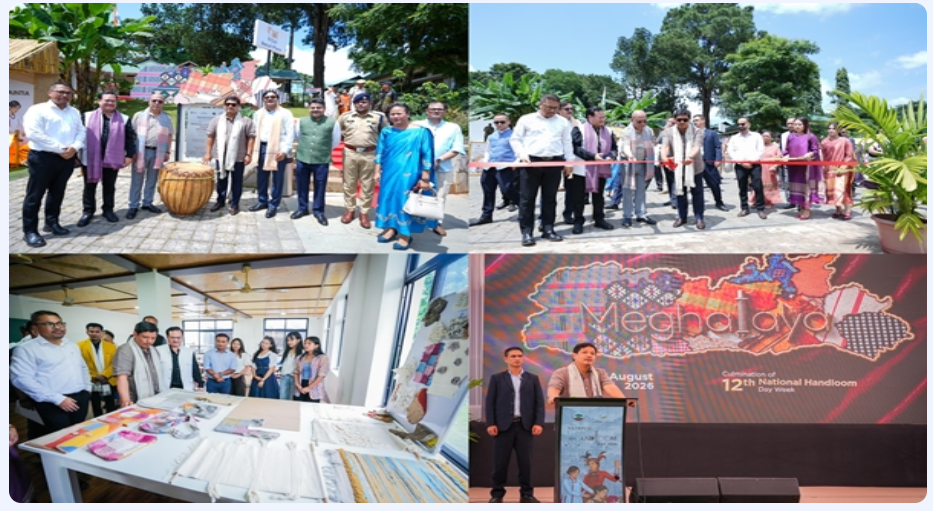
On 14 August 2026, Meghalaya Chief Minister Conrad K. Sangma inaugurated a Centre of Excellence for Eri Silk Weaving at Ri Sai, Integrated Textile Tourism Complex (ITTC), Nongpoh, Ri-Bhoi district, during the culmination of the 12th National Handloom Week and observance of National Handloom Day.
The Centre is intended to preserve traditional Eri-weaving skills, promote skill development and encourage innovation, while passing the craft to younger generations. The Ri Sai complex integrates weaving with training, design, tourism, retail and hospitality. (News On Air)
What is Eri Silk?
Eri Silk, locally known in Khasi as Ryndia, is a traditional silk associated strongly with Meghalaya’s indigenous textile culture.
- Ryndia = Khasi name for Eri silk
- It is also popularly called Ahimsa Silk or Peace Silk.
- The silk is produced through a relatively non-violent process, as the silkworm is allowed to emerge from the cocoon before the cocoon is processed.
- Eri differs from conventional reeled silk because its fibre is generally spun rather than reeled.
- It has a characteristic wool-like texture, making it suitable for Meghalaya’s climate.
- Castor plants are important because their leaves serve as food for Eri silkworms. (Meghalaya Tourism)
Exam Tip:
Eri → Ryndia → Ahimsa/Peace Silk → Castor-fed silkworm → Meghalaya
Why is Ryndia important to Meghalaya?
Ryndia is not merely a textile product. It represents the intersection of:
Culture + Women Empowerment + Sustainable Livelihood + Environment + Tourism + GI Protection
Cultural significance
The weaving tradition has been transmitted through generations, particularly among women. Meghalaya Tourism notes that women participate across the value chain—from silkworm rearing and spinning to dyeing, weaving and marketing. (Meghalaya Tourism)
Thus, Ryndia acts as an important example of traditional knowledge being converted into a livelihood opportunity.
Sustainable textile
Ryndia is associated with:
- Ahimsa/non-violent silk production
- Hand spinning
- Hand weaving
- Natural dyes
- Organic and environmentally conscious production
- Local raw materials
- Women-led production
Natural dye materials mentioned by Meghalaya Tourism include turmeric, onion peel, lac and iron ore. (Meghalaya Tourism)
Umden-Diwon: Meghalaya’s Eri Silk Hub
Important Location
Umden-Diwon, Ri-Bhoi district
It is one of the most important places associated with Eri silk production in Meghalaya.
Key fact
Umden-Diwon was officially declared Meghalaya’s first Eri Silk Village on 12 February 2021. (Ryndia)
The village is known for:
- Traditional Eri silk production
- Skilled weavers and dyers
- Handloom weaving
- Natural dyeing
- Women-led livelihoods
- Cultural tourism
The Design, Innovation & Resource Centre (DIRC) was established at Umden-Diwon in collaboration with NIFT to promote innovation, documentation and dissemination of traditional weaving techniques. (Ryndia)
Remember:
Umden-Diwon → Ri-Bhoi → First Eri Silk Village of Meghalaya
New Centre of Excellence — 2026
The newly inaugurated Centre of Excellence for Eri Silk Weaving at Ri Sai, Nongpoh represents a shift from merely preserving traditional weaving towards skill development, innovation and commercialisation.
Major objectives
- Preservation of traditional knowledge
- Training of the younger generation
- Skill development
- Innovation in weaving and design
- Improvement of market opportunities
- Promotion of Meghalaya’s indigenous textiles
- Integration of textile production with tourism
- Creation of sustainable livelihood opportunities
The Integrated Textile Tourism Complex at Ri Sai brings together textile-related activities with an Ahimsa Silk training and design centre, restaurant, cottages and retail plaza. (India Today NE)
Significance
The initiative reflects a broader policy approach:
Traditional Craft → Skill → Design → Market → Tourism → Sustainable Livelihood
Ryndia and Geographical Indication (GI) Tag
One of the most important exam connections is the GI recognition received by Meghalaya’s textile products in 2025.
In March/April 2025, the GI Registry registered:
1. Meghalaya Ryndia Textile
GI Registration No.: 1112
2. Meghalaya Khasi Handloom Products
GI Registration No.: 1113
Both were registered with geographical area covering Meghalaya. The official GI records show the certificates were dated 28 March 2025. (Intellectual Property India)
The Ministry of Textiles/PIB described the GI recognition as an important milestone for Meghalaya’s indigenous textile sector. (Press Information Bureau)
Why GI matters?
A Geographical Indication (GI) identifies goods whose quality, reputation or characteristics are essentially associated with a particular geographical origin.
For Ryndia, GI recognition can help with:
- Protection against imitation
- Authenticity
- Branding
- Market differentiation
- Better visibility
- Rural livelihood generation
- Preservation of traditional knowledge
Exam connection:
Ryndia Textile — GI No. 1112
Meghalaya Khasi Handloom Products — GI No. 1113 (Intellectual Property India)
Ryndia as an Example of Women-led Development
A major feature of Meghalaya’s Eri silk ecosystem is the central role played by women artisans.
Women are involved in several stages:
Silkworm rearing → Cocoon processing → Spinning → Dyeing → Weaving → Marketing
The Meghalaya Tourism portal describes Ryndia production as a women-centred/gynocentric workforce, with knowledge traditionally transferred from mother to daughter. (Meghalaya Tourism)
Development significance
Ryndia therefore demonstrates how:
- Indigenous knowledge can create employment
- Women can become producers and entrepreneurs
- Traditional skills can be monetised
- Rural communities can participate in value chains
- Sustainable production can support local economies
Eri Silk and Garo Hills
Although Ri-Bhoi and Umden-Diwon are particularly important centres of Meghalaya’s Eri silk tradition, Eri silk initiatives are also expanding in the Garo Hills.
Recent initiatives in Garo Hills highlight:
- Women artisans
- Community-based production
- Sustainable livelihoods
- Natural dyes
- Non-violent silk production
- Cooperative approaches
The Eri Silk Initiative in Garo Hills has been associated with women-led artisan groups and community-based silk production. (GHE)
Exam perspective
Do not assume:
Eri Silk = only Ri-Bhoi
Instead remember:
Ri-Bhoi/Umden-Diwon = major and historically recognised Eri Silk hub; Eri silk activities are also present in other parts of Meghalaya, including Garo Hills.
Eri Silk and Sustainable Development
Ryndia fits well into the contemporary concept of sustainable and ethical fashion.
Environmental dimension
- Natural dyes
- Local raw materials
- Hand production
- Low dependence on industrial processes
- Non-violent silk production
Economic dimension
- Rural employment
- Artisan livelihoods
- Women entrepreneurship
- Value addition
- Market expansion
- Tourism opportunities
Social and cultural dimension
- Preservation of indigenous knowledge
- Intergenerational transmission of skills
- Cultural identity
- Empowerment of women
Thus, Ryndia can be understood through the 3 dimensions of sustainable development:
Environment + Economy + Society
From Traditional Craft to Modern Technology
Meghalaya’s approach is not limited to preserving old techniques.
The state has also experimented with digitalisation and traceability of handloom products.
A pilot project at Umden-Diwon introduced technology to improve authenticity and traceability, including QR-code-based identification of handloom products. (Meghalaya Government)
This is important because GI products can face problems such as:
- Counterfeit products
- Misleading branding
- Loss of consumer confidence
- Lack of traceability
Therefore:
GI + Digital Traceability + Branding = Stronger protection for indigenous products
Government Initiatives Related to Ryndia
The Meghalaya Textiles Department has undertaken several initiatives to strengthen the sector.
Important initiatives
| Initiative | Significance |
|---|---|
| First Eri Silk Village – Umden-Diwon | Promotes Eri silk ecosystem |
| Ryndia brand | Branding and market promotion |
| Design, Innovation & Resource Centre (DIRC) | Design, research, documentation and innovation |
| GI recognition | Protection and authenticity |
| Digitalisation of handloom | Traceability and authentication |
| Integrated Textile Tourism Complex | Links textiles with tourism |
| Centre of Excellence for Eri Silk Weaving | Skill development and preservation |
| Training & capacity building | Upgrading artisan skills |
| National & international exhibitions | Wider market exposure |
The state’s initiatives have increasingly attempted to connect the entire value chain—from farm to fibre, fibre to fabric, fabric to fashion. (Press Information Bureau)
Eri Silk as a Tourism Product
Ryndia also fits into Meghalaya’s growing cultural and experiential tourism model.
Visitors to Umden-Diwon can experience:
- Traditional weaving
- Silk production
- Natural dyeing
- Local culture
- Indigenous food
- Community-based tourism
The state’s textile tourism approach seeks to turn traditional crafts into living cultural experiences, rather than treating them merely as museum artefacts. (Meghalaya Tourism)
Practice MCQs: Eri Silk / Ryndia — Meghalaya Current Affairs
1. With reference to Eri Silk, consider the following statements:
- Eri Silk is locally known as Ryndia in Meghalaya.
- It is popularly associated with the term Ahimsa Silk.
- Castor leaves are an important food source for Eri silkworms.
Which of the statements given above is/are correct?
A. 1 only
B. 1 and 2 only
C. 2 and 3 only
D. 1, 2 and 3
Answer: D
Explanation: Eri Silk is known as Ryndia in Meghalaya and is popularly called Ahimsa/Peace Silk. The Eri silkworm feeds primarily on castor leaves.
2. The term “Ryndia”, frequently mentioned in the context of Meghalaya’s textile heritage, refers to:
A. A traditional Khasi musical instrument
B. A variety of indigenous rice
C. Eri Silk textile
D. A traditional Khasi house
Answer: C
Explanation: Ryndia is the traditional name associated with Eri Silk in Meghalaya.
3. Which one of the following places is particularly associated with Eri Silk production in Meghalaya?
A. Tura
B. Umden-Diwon
C. Jowai
D. Williamnagar
Answer: B
Explanation: Umden-Diwon in Ri-Bhoi district is an important centre of Eri Silk production and was declared Meghalaya’s first Eri Silk Village.
4. Umden-Diwon, which is associated with Eri Silk, is located in:
A. East Khasi Hills
B. West Garo Hills
C. Ri-Bhoi
D. West Jaintia Hills
Answer: C
Explanation: Umden-Diwon is located in Ri-Bhoi district of Meghalaya.
5. Umden-Diwon was declared Meghalaya’s first Eri Silk Village in:
A. 2018
B. 2019
C. 2021
D. 2023
Answer: C
Explanation: Umden-Diwon was declared Meghalaya’s first Eri Silk Village on 12 February 2021.
6. Why is Eri Silk commonly referred to as “Ahimsa Silk”?
A. It is produced without using any plant-based material
B. The silkworm is generally allowed to emerge from the cocoon before the fibre is processed
C. It is produced only through chemical-free farming
D. It is manufactured without using water
Answer: B
Explanation: Eri Silk is popularly called Ahimsa or Peace Silk because its production traditionally does not require killing the silkworm inside the cocoon.
7. Consider the following pairs:
| Textile/Product | State |
|---|---|
| 1. Ryndia | Meghalaya |
| 2. Muga Silk | Assam |
| 3. Eri Silk | Meghalaya |
Which of the pairs given above are correctly matched?
A. 1 only
B. 1 and 2 only
C. 2 and 3 only
D. 1, 2 and 3
Answer: D
Explanation: Ryndia is associated with Meghalaya, Muga is strongly associated with Assam, and Eri Silk is an important traditional silk of Meghalaya.
8. Which of the following received GI recognition along with Meghalaya Ryndia Textile?
A. Meghalaya Khasi Handloom Products
B. Meghalaya Garo Carpet
C. Khasi Bamboo Craft
D. Garo Cotton Textile
Answer: A
Explanation: Meghalaya Khasi Handloom Products also received GI recognition. Its GI registration number is 1113.
9. With reference to the recently inaugurated Centre of Excellence for Eri Silk Weaving in Meghalaya, it was inaugurated by:
A. Mukul Sangma
B. Conrad K. Sangma
C. Prestone Tynsong
D. Ampareen Lyngdoh
Answer: B
Explanation: Meghalaya Chief Minister Conrad K. Sangma inaugurated the Centre of Excellence for Eri Silk Weaving in August 2026.
10. The Centre of Excellence for Eri Silk Weaving inaugurated in 2026 is located at:
A. Tura
B. Jowai
C. Ri Sai, Nongpoh
D. Shillong
Answer: C
Explanation: The Centre is located at Ri Sai, Integrated Textile Tourism Complex (ITTC), Nongpoh, Ri-Bhoi district.
11. The newly established Centre of Excellence for Eri Silk Weaving primarily seeks to:
- Preserve traditional weaving knowledge
- Promote skill development
- Encourage design and innovation
- Connect traditional textiles with tourism
Select the correct answer using the code below:
A. 1 and 2 only
B. 1, 2 and 3 only
C. 2, 3 and 4 only
D. 1, 2, 3 and 4
Answer: D
Explanation: The Centre represents a comprehensive approach combining heritage preservation, skills, innovation, market development and tourism.
12. Which of the following plants is particularly important in the production of Eri Silk?
A. Mulberry
B. Castor
**C. Jute
D. Cotton
Answer: B
Explanation: The Eri silkworm feeds primarily on castor leaves. This distinguishes Eri production from the conventional mulberry silk ecosystem.
13. Consider the following statements regarding Ryndia:
- It is associated with Meghalaya’s indigenous handloom tradition.
- Women play an important role across its production value chain.
- It has received GI recognition.
- It is exclusively produced in urban areas.
Which statement is incorrect?
A. 1
B. 2
C. 3
D. 4
Answer: D
Explanation: Ryndia is strongly associated with rural and community-based production, particularly in areas such as Umden-Diwon. Therefore, statement 4 is incorrect.
14. Which of the following best describes the developmental significance of Ryndia for Meghalaya?
A. It is primarily an industrial textile produced by large factories.
B. It combines indigenous knowledge, women-led livelihoods, sustainable production and cultural tourism.
C. It is mainly an imported textile marketed in Meghalaya.
D. It is exclusively used for industrial purposes.
Answer: B
Explanation: Ryndia demonstrates how traditional knowledge can be linked with livelihoods, women empowerment, sustainability, branding and tourism.
15. The Design, Innovation & Resource Centre (DIRC) associated with Meghalaya’s Eri Silk ecosystem is located at:
A. Umden-Diwon
B. Mairang
C. Nongstoin
D. Ampati
Answer: A
Explanation: The DIRC at Umden-Diwon supports design development, innovation, documentation and dissemination of traditional weaving techniques.
16. Which of the following is NOT generally associated with the traditional Eri Silk production system?
A. Natural dyes
B. Hand spinning
C. Handloom weaving
D. Highly mechanised factory-based production
Answer: D
Explanation: Eri Silk is strongly associated with traditional hand spinning, handloom weaving and natural dyeing, rather than highly mechanised factory production.
17. Consider the following statements about the GI tag for Meghalaya’s Ryndia Textile:
- It can help protect the product’s geographical identity.
- It can help distinguish authentic products from imitations.
- It can contribute to branding and market promotion.
- It automatically guarantees that every producer will receive a fixed minimum income.
Which of the statements given above is/are correct?
A. 1, 2 and 3 only
B. 1 and 4 only
C. 2, 3 and 4 only
D. 1, 2, 3 and 4
Answer: A
Explanation: A GI can provide legal protection, authenticity and market differentiation, but it does not automatically guarantee a fixed income to every producer.
Mains Perspective
Possible MCS Mains Question
“Ryndia is more than a traditional textile of Meghalaya; it represents the convergence of cultural preservation, women empowerment, sustainable development and rural livelihood. Discuss.”
Points for Answer
Introduction:
Ryndia, the Meghalaya form of Eri silk, is an indigenous handwoven textile traditionally produced through an Ahimsa/non-violent process.
Body:
Cultural
- Preserves indigenous weaving traditions
- Intergenerational knowledge transfer
- Represents Meghalaya’s cultural identity
Economic
- Generates rural employment
- Supports weavers, rearers and artisans
- Creates scope for entrepreneurship and exports
Women empowerment
- Women participate throughout the production chain
- Strengthens household and community incomes
Environmental
- Ahimsa production
- Natural dyes
- Handloom-based production
- Sustainable fashion
Institutional support
- First Eri Silk Village at Umden-Diwon
- DIRC
- GI recognition
- Digital traceability
- Integrated Textile Tourism Complex
- Centre of Excellence
Challenges
- Limited market access
- Counterfeit products
- Need for design innovation
- Need for better branding and quality control
- Youth migration and declining traditional skills
- Scaling production without losing authenticity
Way Forward
- GI-based branding
- Digital traceability
- E-commerce
- Skill development
- Design collaborations
- Textile tourism
- Stronger cooperatives/SHGs
- Youth participation
Conclusion:
The Ryndia model demonstrates how traditional knowledge can become a contemporary development asset when supported by technology, institutional investment, GI protection, tourism and market access.
Sources for further reading
- News On AIR — Centre of Excellence for Eri Silk Weaving
- Meghalaya Tourism — Eri Silk: Threads of Tradition
- Meghalaya Tourism — Eri Silk Village, Umden
- PIB — GI Tag for Meghalaya’s Ryndia
- Official GI Registry — Meghalaya Ryndia Textile (GI No. 1112)
- Official GI Registry — Meghalaya Khasi Handloom Products (GI No. 1113)