

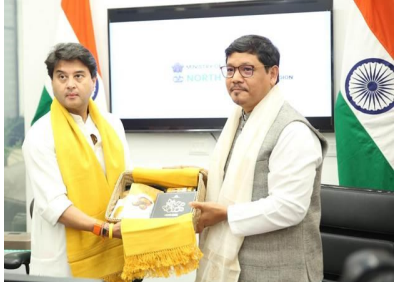
Source: DIPR Meghalaya
Why in News?
The Union Minister for Communications and Development of North Eastern Region, Jyotiraditya M. Scindia, along with Meghalaya Chief Minister Conrad K. Sangma, launched “Mission Golden Spice – Integrated Lakadong Turmeric Value Chain Enhancement Project” on 21 July 2026. The mission aims to transform Meghalaya’s GI-tagged Lakadong turmeric into a globally competitive premium agricultural product.
Key Features of the Mission
- Financial Outlay: ₹175.45 crore.
- Duration: Five-year project, covering 2026–2030.
- Implementing framework: Launched under the USP (Unlock the Economic Potential of India’s Northeast) initiative of the Ministry of Development of North Eastern Region (MDoNER).
- Target: Expand Lakadong turmeric cultivation to approximately 7,000 hectares.
- Farmer Welfare: Aim to double farmers’ incomes.
- Women Empowerment: Creation of more than 3,000 women-led jobs.
- Economic Goal: Develop a ₹100-crore Lakadong turmeric economy by FY 2028–29.
- Approach: Development of an integrated farm-to-global-market value chain, covering cultivation, processing, branding, quality assurance, packaging and marketing.
About Lakadong Turmeric
Lakadong turmeric is a distinctive variety cultivated mainly in the Jaintia Hills region of Meghalaya. It is renowned for its naturally high curcumin content, which gives it strong colour and makes it highly valuable in the food, pharmaceutical, nutraceutical and cosmetic industries.
It received the Geographical Indication (GI) tag in 2024, strengthening its identity as a unique product of Meghalaya.
Significance
1. Agricultural Value Addition:
The mission seeks to move beyond the sale of raw turmeric by promoting processing, branding and value-added products.
2. Farmer-Centric Development:
By strengthening the entire value chain, the mission aims to increase farmers’ income and reduce dependence on intermediaries.
3. Women-Led Economic Growth:
The focus on more than 3,000 women-led jobs highlights the role of women in rural entrepreneurship and agro-processing.
4. GI-Based Regional Branding:
Lakadong turmeric can serve as a flagship “Brand North East” product and demonstrate how GI-tagged products can promote local economic development.
5. Atmanirbhar North East:
The mission reflects the broader vision of making the North-East a hub of high-value agriculture, entrepreneurship and global trade.
Way Forward
For the long-term success of Mission Golden Spice, Meghalaya should focus on:
- Ensuring GI authenticity and traceability.
- Expanding organic and sustainable cultivation.
- Developing modern processing and storage infrastructure.
- Promoting farmer-producer organisations and cooperatives.
- Creating strong international branding and export channels.
- Supporting research into curcumin-based nutraceutical and pharmaceutical products.
Conclusion
Mission Golden Spice is more than a turmeric cultivation programme; it is a value-chain transformation initiative. By converting Meghalaya’s indigenous Lakadong turmeric into a globally recognised premium product, the mission has the potential to increase farmer incomes, create rural employment, empower women and strengthen the economic integration of the North-East with national and global markets.
Practice MCQs
1. With reference to Mission Golden Spice, consider the following statements:
- It focuses on strengthening the value chain of Lakadong turmeric.
- It aims to develop Lakadong turmeric from farm production to global markets.
- It is exclusively a programme for increasing turmeric cultivation without any focus on processing or branding.
Which of the statements given above is/are correct?
A. 1 and 2 only
B. 2 and 3 only
C. 1 and 3 only
D. 1, 2 and 3
Answer: A
Explanation: Mission Golden Spice follows an integrated value-chain approach covering cultivation, processing, branding, quality assurance, packaging and marketing.
2. Mission Golden Spice is primarily associated with which agricultural product?
A. Khasi Mandarin
B. Lakadong Turmeric
C. Black Pepper of Meghalaya
D. Sohiong
Answer: B. Lakadong Turmeric
Explanation: The mission aims to enhance the value chain of Meghalaya’s premium Lakadong turmeric.
3. Lakadong turmeric is primarily associated with which region of Meghalaya?
A. Garo Hills
B. Khasi Hills
C. Jaintia Hills
D. Ri-Bhoi
Answer: C. Jaintia Hills
Explanation: Lakadong turmeric is traditionally cultivated mainly in the Jaintia Hills region of Meghalaya.
4. Which one of the following characteristics makes Lakadong turmeric particularly valuable?
A. High caffeine content
B. High curcumin content
C. High starch content
D. High oil content
Answer: B. High curcumin content
Explanation: Lakadong turmeric is known for its naturally high curcumin content, which gives it strong colour and enhances its value in food, pharmaceutical and nutraceutical industries.
5. Consider the following sectors:
- Food processing
- Pharmaceuticals
- Nutraceuticals
- Cosmetics
Lakadong turmeric has potential applications in how many of the above sectors?
A. Only one
B. Only two
C. Only three
D. All four
Answer: D. All four
Explanation: Its high curcumin content gives Lakadong turmeric applications across all these sectors.
6. The Geographical Indication (GI) tag for Lakadong turmeric primarily helps in:
- Establishing its geographical identity.
- Protecting its unique regional reputation.
- Preventing unauthorised use of its name for products not originating from the region.
Select the correct answer using the code below:
A. 1 only
B. 1 and 2 only
C. 2 and 3 only
D. 1, 2 and 3
Answer: D. 1, 2 and 3
Explanation: A GI tag identifies goods originating from a specific geographical region and protects their unique reputation and identity.