

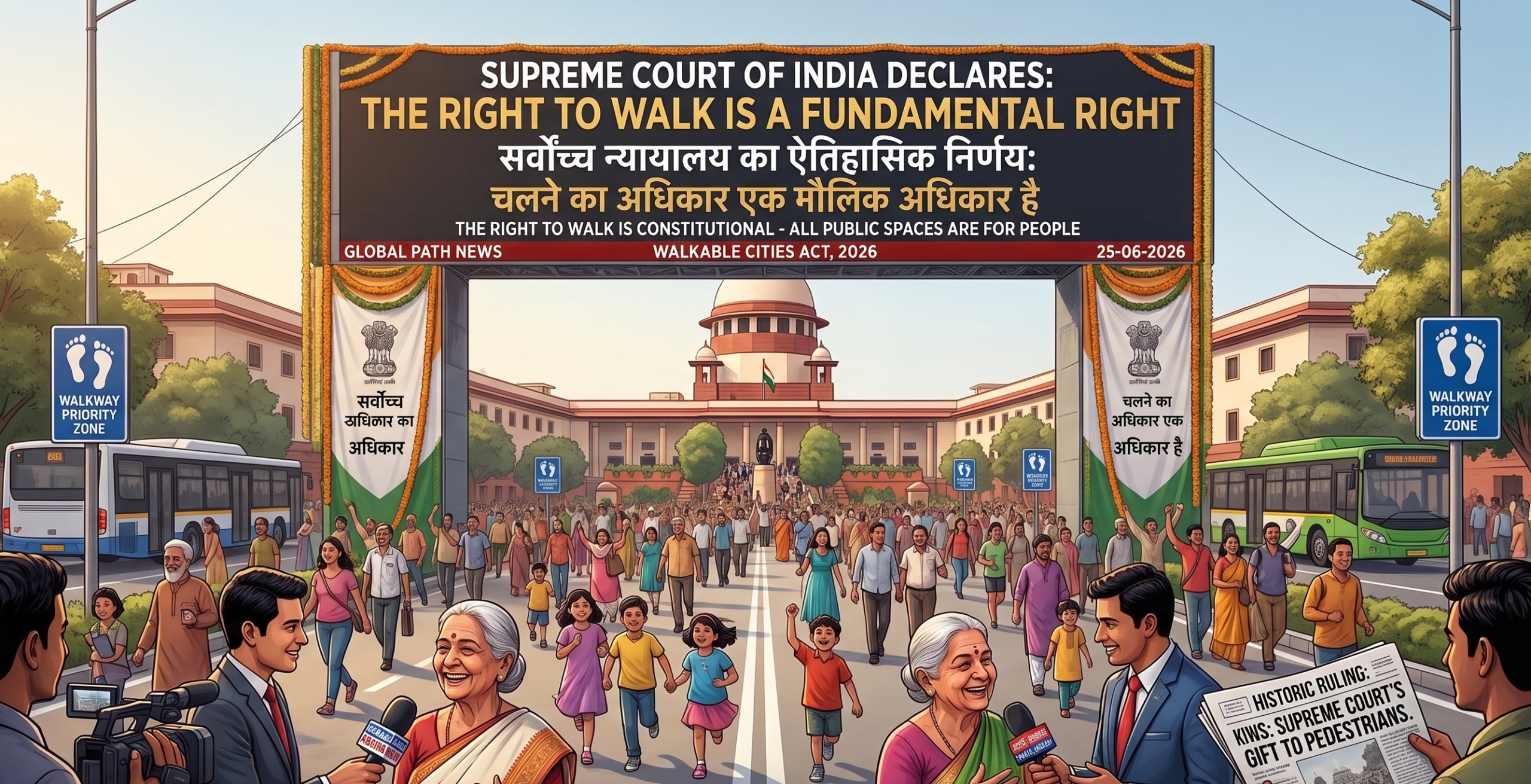
Why in News?
The Supreme Court, in a landmark judgment delivered on 19 June 2026, declared that the right to walk on safe and demarcated footpaths is a Fundamental Right under Part III of the Constitution. The Court held that pedestrian rights take precedence over the movement of motorized vehicles and directed authorities to ensure proper pedestrian infrastructure.
Key Highlights of the Judgment
- The Supreme Court held that the right to walk is an integral part of the freedom of movement under Article 19(1)(d) and the Right to Life under Article 21.
- The Court observed that the right to walk includes the right to safe, accessible, and well-demarcated footpaths.
- Pedestrian movement has been given priority over motorized vehicles.
- Urban Development Authorities, Municipal Corporations, Municipalities, and Panchayats have a duty to construct, maintain, and protect pedestrian infrastructure.
- Citizens can seek legal remedies and compensation if their right to walk is violated.
- The Court recommended establishing a regulatory mechanism or statutory framework to safeguard pedestrian rights.
Constitutional Basis
Article 19(1)(d)
- Guarantees the freedom to move freely throughout the territory of India.
- The Court held that walking is the most basic form of movement protected under this Article.
Article 21
- Guarantees the Right to Life and Personal Liberty.
- Safe pedestrian infrastructure is essential for a dignified and secure life.
Expanded Interpretation
The Court noted that walking also facilitates:
- Freedom of expression (Article 19(1)(a))
- Freedom of assembly (Article 19(1)(b))
- Freedom of association (Article 19(1)(c))
Case Background
The judgment arose from a case involving the death of a five-year-old child who was run over by a tanker while walking to school due to the absence of safe pedestrian infrastructure. The Court used the case to address the broader issue of pedestrian rights in India.
Significance of the Judgment
Urban Planning
- Encourages the development of walkable cities.
- Promotes sustainable and inclusive urban infrastructure.
Road Safety
- Reduces pedestrian fatalities and accidents.
- Prioritizes vulnerable road users such as children, elderly persons, and persons with disabilities.
Environmental Benefits
- Encourages non-motorized transport.
- Supports sustainable mobility and reduced carbon emissions.
Good Governance
- Increases accountability of local bodies for maintaining footpaths and pedestrian facilities.
Challenges
- Encroachment of footpaths by vendors and unauthorized structures.
- Poor maintenance of sidewalks.
- Lack of pedestrian-friendly urban planning.
- Funding and implementation constraints for local bodies.
Previous Expansion of Article 21
The Supreme Court has previously interpreted Article 21 to include:
- Right to Privacy
- Right to Clean Environment
- Right to Education (before Article 21A)
- Right to Livelihood
- Right to Health
- Right against adverse effects of climate change
The Right to Walk further expands the scope of fundamental rights in India.
Exam Pointers
- Right to Walk declared a Fundamental Right in June 2026
- Linked to Articles 19(1)(d) and 21
- Footpaths must be safe, demarcated, and maintained
- Pedestrian rights take priority over motorized vehicles
- Duty lies with Municipalities, Urban Development Authorities, and Panchayats
- Citizens can seek compensation for violation of pedestrian rights
- Judgment arose from a pedestrian accident involving a five-year-old child
Prelims Practice Question
Q. Consider the following statements regarding the Supreme Court’s 2026 judgment on the Right to Walk:
- The Court held that the right to walk is part of the freedom of movement under Article 19(1)(d).
- The right to walk includes access to safe and demarcated footpaths.
- The Court held that pedestrian rights have priority over motorized vehicles.
- The responsibility for maintaining footpaths lies exclusively with State Governments.
Which of the statements given above are correct?
(A) 1 and 2 only
(B) 1, 2 and 3 only
(C) 2, 3 and 4 only
(D) 1, 2, 3 and 4
Answer: (B)
Mains Practice Question
“The Supreme Court’s recognition of the Right to Walk as a Fundamental Right marks a significant step towards inclusive urban governance.” Discuss the constitutional basis, significance, and challenges associated with implementing this right in India. (250 words)